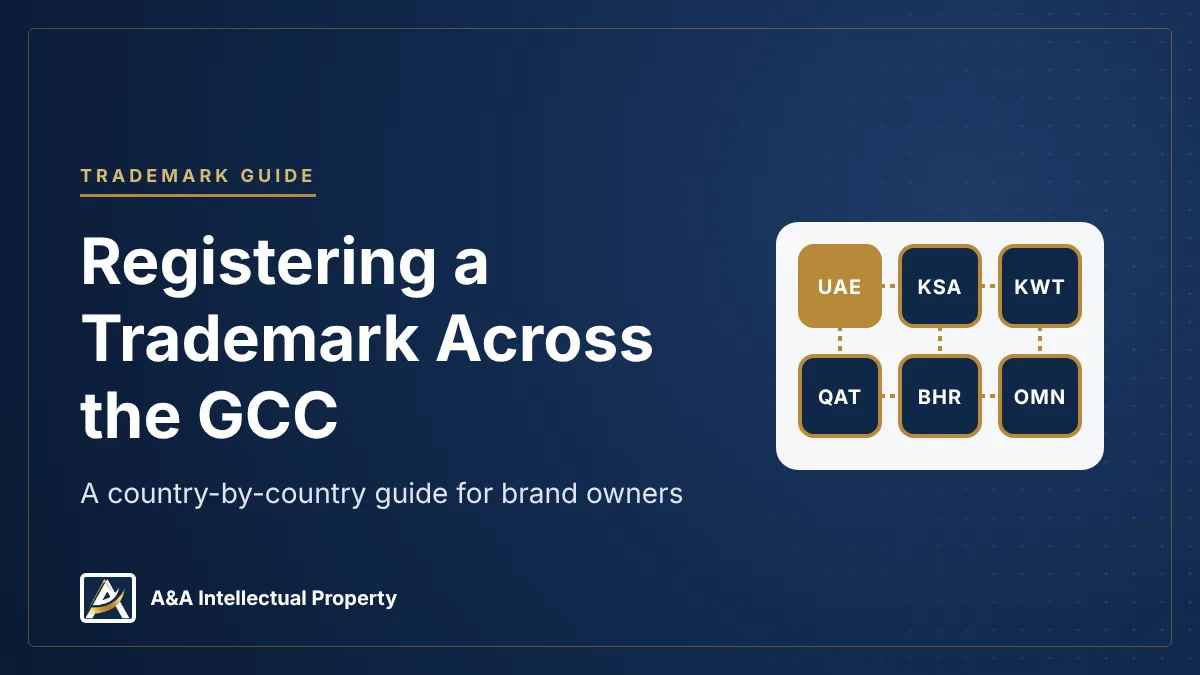
Many businesses that start in the UAE soon sell into Saudi Arabia, Kuwait, Qatar, Bahrain or Oman. A common assumption is that one registration covers the whole Gulf. It does not. Each of the six GCC countries grants its own trademark rights, and a mark registered in the UAE is not protected in Riyadh or Kuwait City unless it is also registered there.
A shared law, but no single registration
The GCC states agreed a common trademark law to bring their rules closer together. It harmonises many principles, but it did not create a single Gulf-wide trademark or a single filing office. Protection is still obtained country by country, and each office examines, publishes and registers marks under its own procedures, deadlines and fees.
Two ways to file: national applications or the Madrid System
- National applications are filed directly with the trademark office of each country, usually through a local agent.
- The Madrid System lets you extend an existing home application or registration to other member countries through one international application filed via your home office.
The UAE, Bahrain, Oman and Qatar are members of the Madrid System. Saudi Arabia joined in 2026, and the Madrid Protocol has applied there since 8 October 2026. Kuwait is currently the only GCC country that is not a member, so protection in Kuwait still requires a national application.
Madrid can reduce paperwork and centralise renewals, but it has limits. For five years the international registration depends on the home application or registration, so if the base mark is refused or cancelled in that period, the designations can fall with it. Some offices also prefer goods and services worded in their own accepted terms. For an overview of how the system works from the UAE, see our guide to the Madrid System.
One class per application
Across the GCC, national applications cover one class of goods or services each. If your brand covers clothing, bags and retail services, that usually means three separate applications in every country you choose. This is the main reason GCC budgets grow quickly, so it pays to decide early which classes really matter in each market.
Country points worth knowing
- UAE: applications are examined by the Ministry of Economy and published for opposition before registration. Read our articles on opposition and renewal.
- Saudi Arabia: national filings use a prescribed list of goods and services, so the description must be chosen from approved wording.
- Kuwait: also works with prescribed descriptions, and an official availability search is not offered in the same way as elsewhere, so checking the published marks is important before filing.
- Qatar, Bahrain and Oman: allow freer drafting of the goods and services, which makes careful drafting even more important.
Documents
Expect to provide the applicant's details, a clear image of the mark and a power of attorney for the local agent. Some countries require the power of attorney to be legalised, while others accept an apostille or a simple signature at certain stages. Requirements change, so confirm them for each country before you sign.
Arabic and English versions of the mark
Across the Gulf your brand will be seen in both scripts. A mark filed only in English may not cover how customers write or say it in Arabic, and a similar name in Arabic letters can block your application. Plan which versions you need, as explained in our article on Arabic and English trademarks.
A practical GCC filing plan
- List your markets and classes: where you sell now, where you will sell in the next two to three years, and which goods or services you actually offer.
- Search before filing in each priority country and class. Start with our free UAE trademark search for a first indication.
- Choose the route: national filings, Madrid, or a mix, for example Madrid for member states and a national filing in Kuwait.
- Prepare documents once and check which countries need legalisation.
- Watch and renew: track publications for conflicting marks and keep a single renewal calendar for all six countries.
How we can help
A&A Intellectual Property files and manages trademarks in the UAE and coordinates filings across the GCC. See our GCC trademark registration service, or request a quote for the countries and classes you need.
This article gives general information only and is not legal advice. Procedures and fees in each country change from time to time.