Every year many trademark applications in the UAE are refused or held up by the Ministry of Economy and Tourism. Most of these problems are predictable, and most can be avoided before you file. This guide explains why applications are refused, what happens when the Ministry raises an objection, and how to protect your filing fees by preparing well.
The legal basis: Article 3 of the Trademarks Law
Federal Decree-Law No. 36 of 2021 on Trademarks lists the signs that cannot be registered. In practice, the grounds the Ministry uses most often fall into a few groups.
1. The mark is not distinctive
A mark must be able to tell your goods or services apart from those of others. Common words that simply describe the product, its quality or its purpose, such as BEST COFFEE for coffee or FAST DELIVERY for courier services, are usually refused. The same applies to generic names of products and to single letters or simple shapes with no distinctive design.
2. The mark conflicts with an earlier mark
This is the most common reason for refusal. The law excludes marks that are identical or similar to a mark already filed or registered by someone else for the same or related goods or services, where the public could be confused. The comparison covers spelling, sound and meaning, and also the Arabic and English versions of a name. A mark that copies, imitates or translates a well-known mark can be refused even for different goods.
3. Public order, religion and official symbols
Marks that offend public morals or public order are excluded, as are religious symbols, flags, state emblems, official badges, coins and banknotes, and the Red Crescent and Red Cross symbols or signs imitating them.
4. Misleading marks and geographical names
A mark that could mislead the public about the origin, nature or quality of the goods is refused. Geographical names are excluded where their use could cause confusion about where the goods come from.
5. Names and images of other people
The name, surname, photograph or nickname of another person cannot be registered without that person's prior consent, or the consent of the heirs. If your brand uses a real person's name, prepare the written consent before filing.
6. Protected words and certain shapes
Words such as "registered", "copyright" or "patent" cannot form part of the mark, and a three-dimensional mark cannot consist only of a shape that results from the nature of the goods.
What happens when the Ministry objects
Not every objection is a final refusal. The Ministry may ask for changes, for example limiting the list of goods, adding a disclaimer or clarifying the mark. Under the law, the applicant must reply within 30 days of being notified. An application without a reply in time is treated as abandoned, and the official fees are lost.
If the application is refused: the grievance
A refusal can be challenged. The applicant may file a grievance with the Grievance Committee within 30 days of receiving the refusal notice. A good grievance answers the exact reason given: it explains why the marks are different, narrows the goods where needed, and attaches evidence such as use in the market or registrations abroad. If the Committee upholds the refusal, the law allows an appeal to the competent court within 30 days of being notified of its decision; court proceedings are handled by a licensed advocate.
Opposition after publication
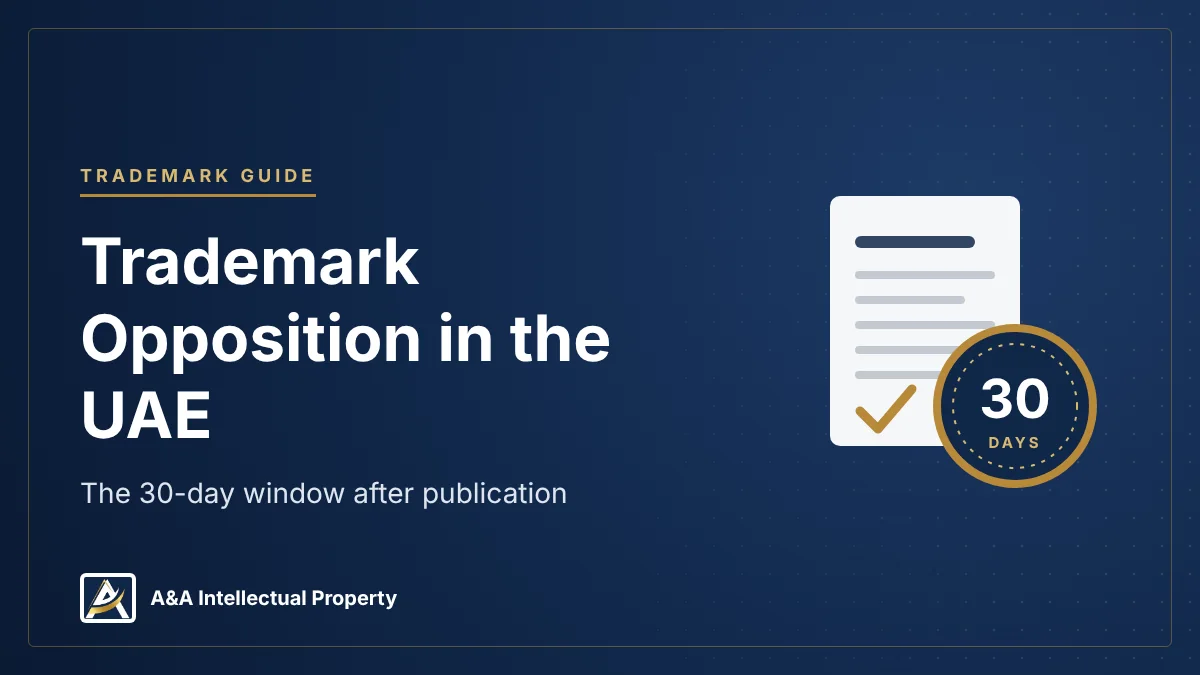
Even after acceptance, the application is published in the Trademark Bulletin and any interested party may oppose it within 30 days. A careful search before filing also reduces this risk.
Seven ways to avoid a refusal
- Search first. Run a free trademark search in the classes you need, in English and Arabic.
- Choose an inventive name. Invented or arbitrary words are the easiest to register and the strongest to enforce.
- Avoid descriptive words on their own. If you use one, combine it with a distinctive element.
- Pick the right classes. Use our class finder and describe your goods precisely.
- Check the Arabic version. A transliteration or translation can clash with an existing Arabic mark.
- Get consents early. Personal names and images need written approval before filing.
- Watch the deadlines. Thirty days to reply to an objection, thirty days to file a grievance.
How we can help
A&A Intellectual Property checks your mark before filing, prepares the application and replies to Ministry objections and grievances. You can start your application online and see the price straight away, or contact us if you have already received an objection or refusal.
This article gives general information only and is not legal advice.